
AI Integration Services
MAKE AI WORK WITH YOUR
EXISTING SYSTEMS.
For established U.S. mid-market companies running on multiple systems, fragmented data, and complex workflows, packaged AI integrations are often too limited. Neologic integrates AI into the software and data you already rely on to automate manual work, surface exceptions, support decisions, and add new capabilities without replacing what already works. I map the business rules, permissions, systems, and production requirements up front, then my team of senior engineers builds and deploys the production-ready integration.

★★★★★
44 reviews
AI INTEGRATION & AUTOMATION SERVICES
What AI Integrations Can We Do?
AI integration connects models and agents to the software, data, and workflows your business already uses. The goal is practical: retrieve better context, detect exceptions, reduce manual work, support decisions, and take controlled actions inside existing operations.
CRM Data
Next Action
Connect AI to your CRM to summarize activity, update records, flag missing information or unusual cases, and surface the next action for the right person.
Embedded AI
USER Permissions
Add AI search, copilots, recommendations, document analysis, or agent workflows directly to an existing product. I design the AI layer around the current architecture, users, permissions, and data instead of rebuilding the application around AI.
AI Customer Service Integration
Support data
Human Escalation
Give support AI access to customer records, order data, support tickets, and approved knowledge. It can classify requests, draft contextual responses, route issues, and escalate exceptions to a person.
RAG & Internal Knowledge Assistants
Private knowledge
Grounded Answers
A retrieval-augmented generation (RAG) system lets employees search and ask questions across proprietary documents and knowledge bases. It retrieves relevant company information before generating an answer.
AI Agents & Workflow Automation
Tool actions
Approval gates
AI agents can retrieve data, check conditions, detect conflicts, prepare recommendations, and update systems across multi-step workflows. They can connect through APIs, MCP, or other integration layers, with approval gates for higher-risk actions.
Document & Back-Office AI Automation
Extract + Validate
Workflow Routing
Use AI to extract, classify, summarize, validate, and route information from contracts, forms, reports, emails, and other unstructured documents.
Cross-System decision support
Unified Context
DECISION SUPPORT
Bring context together from several applications so AI can compare related information, surface what matters, and prepare the next best action without forcing employees to check each system manually.
AI Integration With Legacy Software
API / ADAPTER
NO FULL REBUILD
Older software does not automatically need to be replaced before you can use AI. We can expose the data and functions AI needs through APIs, databases, or a new integration layer while leaving the parts of the existing system that still work in place.
INDUSTRIES
What Industries Does Neologic Support With AI Integration?
Neologic supports AI integration in healthcare and home care, legal, financial services, real estate, logistics, manufacturing, and other specialized or regulated industries. These environments often involve complex workflows, sensitive data, business rules, and existing systems that require more than a standard AI connector.
AI Integration for Healthcare
We integrate AI into healthcare workflows, data, and existing systems to support documentation, internal knowledge, scheduling, administrative work, and other operational processes. I design the architecture around access controls, human oversight, and HIPAA requirements where protected health information is involved.
AI for Legal Workflows
We connect AI to case data, documents, intake systems, internal knowledge, and existing legal software. The goal is to reduce repetitive research and administrative work while maintaining appropriate control over sensitive client information.
AI Integration for Financial Services
We integrate AI with financial data, documents, customer records, reporting systems, and back-office workflows. I define the architecture around permissions, auditability, human approvals, and the controls required for sensitive financial information.
AI for Real Estate
We connect AI to property data, documents, CRM systems, tenant or broker communications, and portfolio workflows. This is especially useful when employees have to assemble context manually from several systems before they can act.
AI Integration for Logistics
We integrate AI with dispatch, tracking, quoting, customer service, and operational systems. AI can help surface exceptions, bring related information together, and support faster decisions across day-to-day operations.
AI for Specialized & Regulated Industries
Neologic is a strong fit for businesses with specialized workflows, complex rules, or regulatory requirements. Generic AI products and packaged AI integration services often cannot accommodate that level of operational complexity.
Production readines
How Do We Make AI Integration Secure, Reliable, and Production-Ready?
A production AI integration has to be designed for failure, not just success in a demo. I define what the AI can access and do, how we test its output, and what happens when something goes wrong.
01. DATA & ACCESS
CONTROL WHAT AI CAN SEE
- Reliable Data: Defined sources of truth and data validation.
- Access Control: SSO, RBAC, and least-privilege permissions.
- Sensitive Data: Security and compliance controls, including HIPAA where applicable.
02. AI BEHAVIOR & CONTROL
CONTROL WHAT AI CAN DO
- Output Quality: Evals, regression testing, human review, and acceptance criteria.
- Agent Actions: Restricted tools, permissions, and approval gates for sensitive actions.
- Prompt Injection & Misuse: Input/output validation and clear permission boundaries.
03. RELIABILITY & OPERATIONS
KNOW WHEN SOMETHING BREAKS
- Failures & Recovery: Fallbacks, retries, error handling, and escalation paths.
- Performance & Cost: Latency monitoring, caching, model selection, and usage controls.
- Observability: Tracing, audit logs, and production monitoring.
THE NEOLOGIC PROBLEM-TO-PRODUCTION AI FRAMEWORK
How Do We Integrate AI Into Existing Systems?
I lead the diagnosis, architecture, and scope before my engineering team starts the production build. We prove the approach first, lock the scope and budget, then build, launch, and measure what actually works.
01. Discovery call
02. Audit
03. PROTOTYPE
04. Build
05. Launch & Support
01
Discovery Call
30 -60 MINS
NO IS A VALID ANSWER
I start with the business problem, current workflow, existing systems, and what you want to improve. We determine whether AI is worth pursuing or whether conventional automation, a software change, or no build at all makes more sense.
deliverable
A clear technical diagnosis and immediate next steps.
02
Top-Down Audit
1-2 WEEKS
Workflow
Data
I map the workflow, systems, handoffs, business rules, exceptions, and data the AI will depend on. I also define what the AI may access, recommend, or change, where human approval is required, and what production risks have to be controlled.
deliverable
A workflow and system map, data requirements, guardrails, and proposed integration architecture.
03
Prototype & Guarantee
1-2 WEEKS
SCOPE LOCKED
BUDGET GUARANTEED
We test the proposed experience and AI behavior before committing to the full production build. The prototype uses representative workflows, data, edge cases, and failure conditions to expose technical unknowns while changes are still inexpensive. Once the approach and fixed scope are approved, I lock the agreed production build budget.
deliverable
A validated prototype, approved production scope, and locked build budget for fixed-scope work.
04
Engineering & Execution
2-6 MONTHS
1 POINT OF CONTACT
0 SILENT UPCHARGES
My engineering team builds the approved AI integration and connects it to the systems already running the business. This is where integrations, permissions, human controls, evals, failure handling, monitoring, security, and production infrastructure come together.
I remain accountable for the architecture and technical direction throughout the build.
deliverable
A production AI integration built to the approved architecture, scope, and budget.
05
Launch & Support
100% IP OWNERSHIP
NO VENDOR LOCK-IN
CHICAGO SLA
We deploy the integration into the real operation, document the system, support users through launch, and monitor how it behaves in production. Where the project has measurable operational goals, those results can guide what is worth improving or expanding next.
You own the custom code and IP we create, with ongoing support available when needed.
deliverable
A deployed, documented system with clear ownership, production monitoring, and ongoing support options.
AI Tech stack
What AI Technologies Do We Use?
We are not tied to one AI model, framework, or cloud. I select the stack around the use case, existing systems, data, security requirements, and operating cost.
AI Models
LLM Integration
Multimodal AI
OPEN + PROPRIETARY MODELS

Search, RAG & Retrieval
semantic + hybrid search
private knowledge
vector + keyword retrieval
AI Agents & Orchestration
TOOL USE
MCP
HUMAN APPROVAL
Integration & Backend
REST APIs
WEBHOOKS
CUSTOM CONNECTORS
Production, Security & Observability
EVALS + TRACING
SSO + ROLE-BASED ACCESS
MONITORING + FALLBACKS
AI Integration Case Studies
What Does AI Integration Look Like in Practice?
Healthcare
Logistics
B2B SaaS
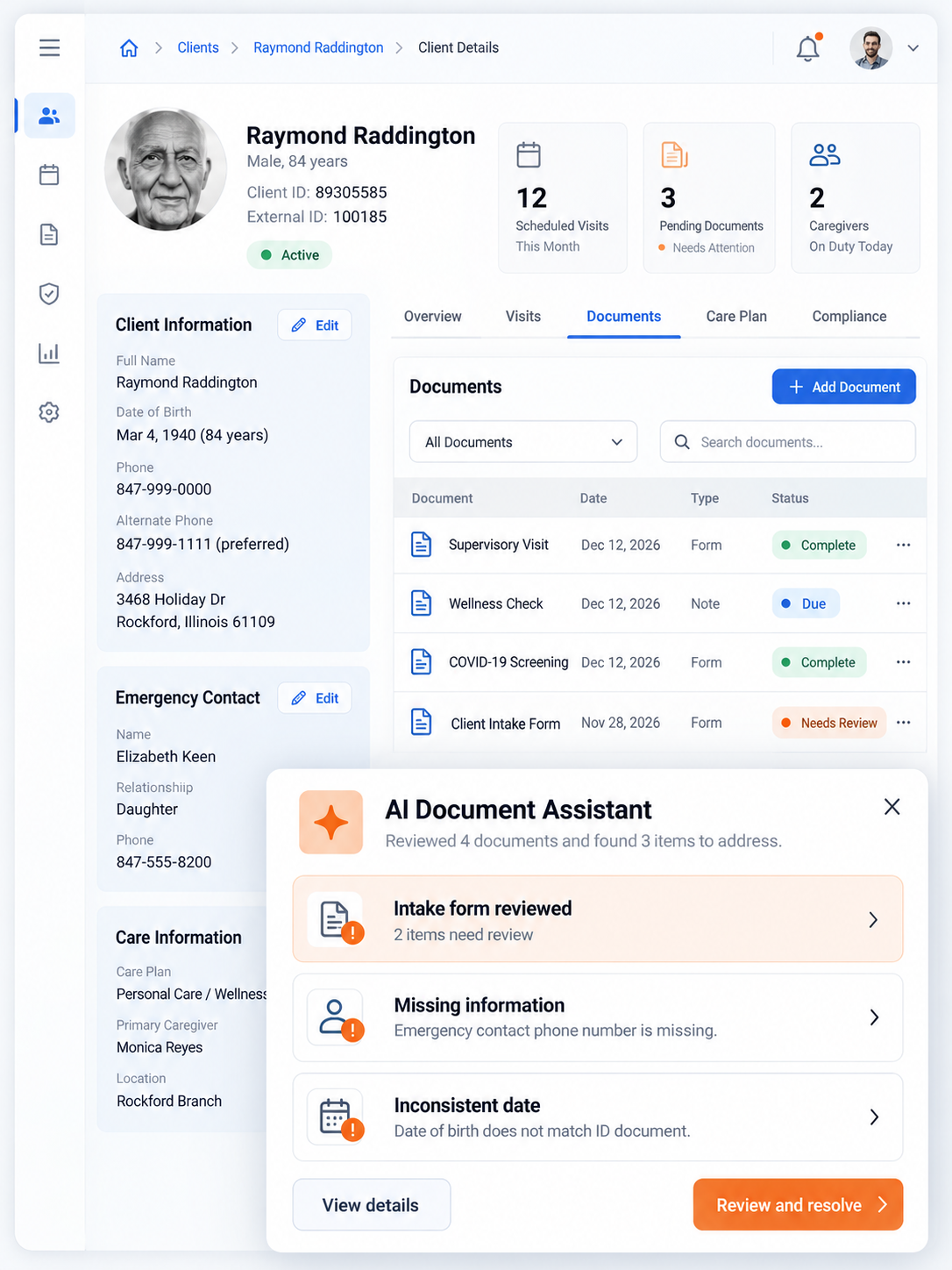
AI INTEGRATION ACROSS A COMPLEX HOME CARE OPERATION
A multi-location home care provider was managing scheduling, documentation, compliance, and administrative workflows across an existing custom platform and disconnected data sources. I designed an AI integration layer around the systems already in place; my team connected document processing, operational data, and workflow rules without replacing the core platform.
38%
Less manual document review and data entry.
120+ hrs
Administrative time saved each month.
52%
Faster identification of missing or inconsistent information.
Home Care
Custom Software
Document AI
Workflow Automation
Human Review
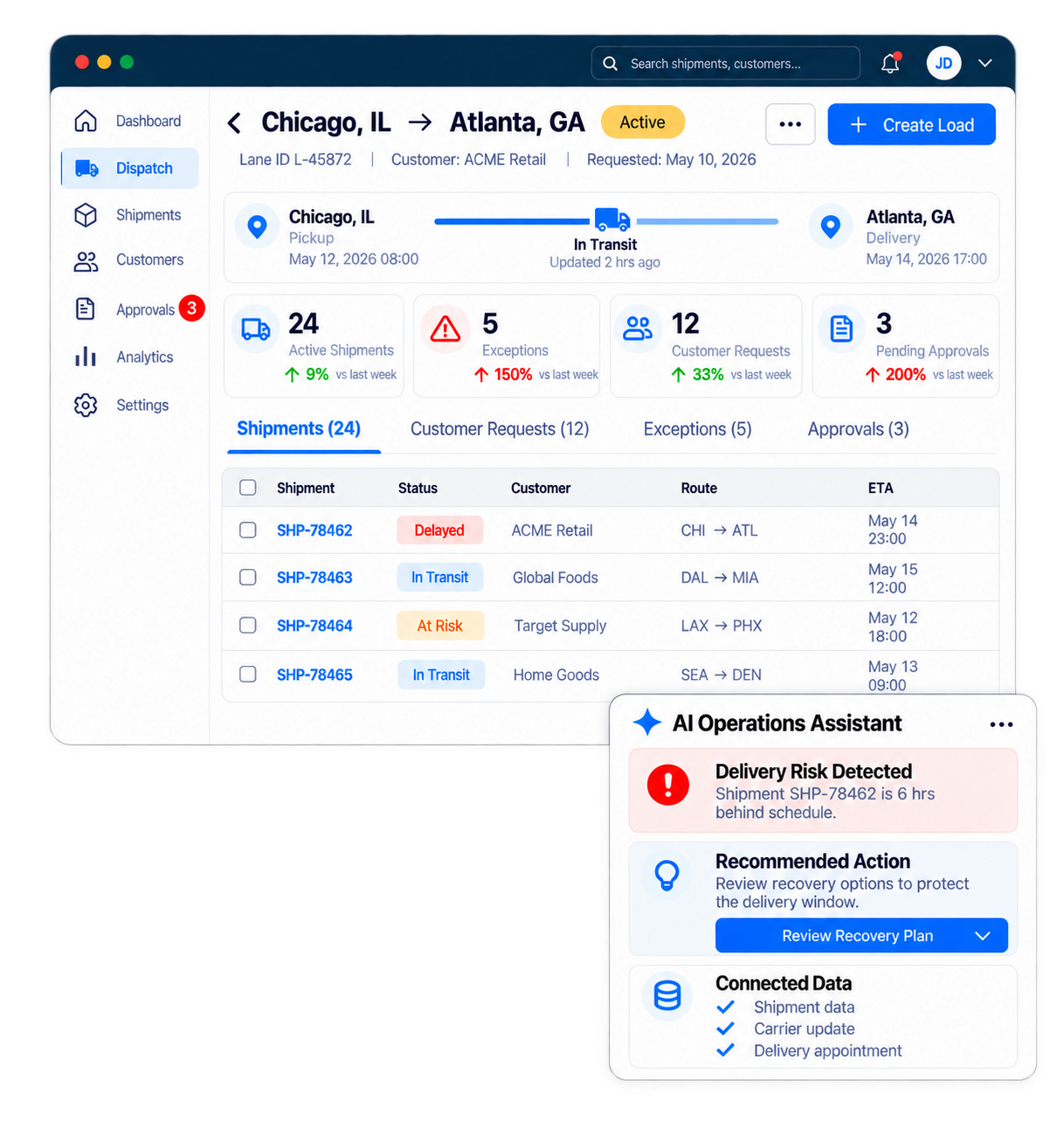
AI AGENT CONNECTED DISPATCH, CUSTOMER, AND OPERATIONS DATA
A logistics company needed faster decisions across dispatch, shipment data, customer requests, and internal systems. I designed an AI workflow that could retrieve context from multiple applications, detect operational issues, prepare recommended actions, and route higher-risk decisions to employees for approval.
44%
Faster handling of operational exceptions.
85+ hrs
Manual coordination eliminated each week.
31%
Reduction in repetitive status and data-checking work.
Logistics
MULTIPLE SYSTEMS
AI AGENTS
APIs
HUMAN APPROVAL
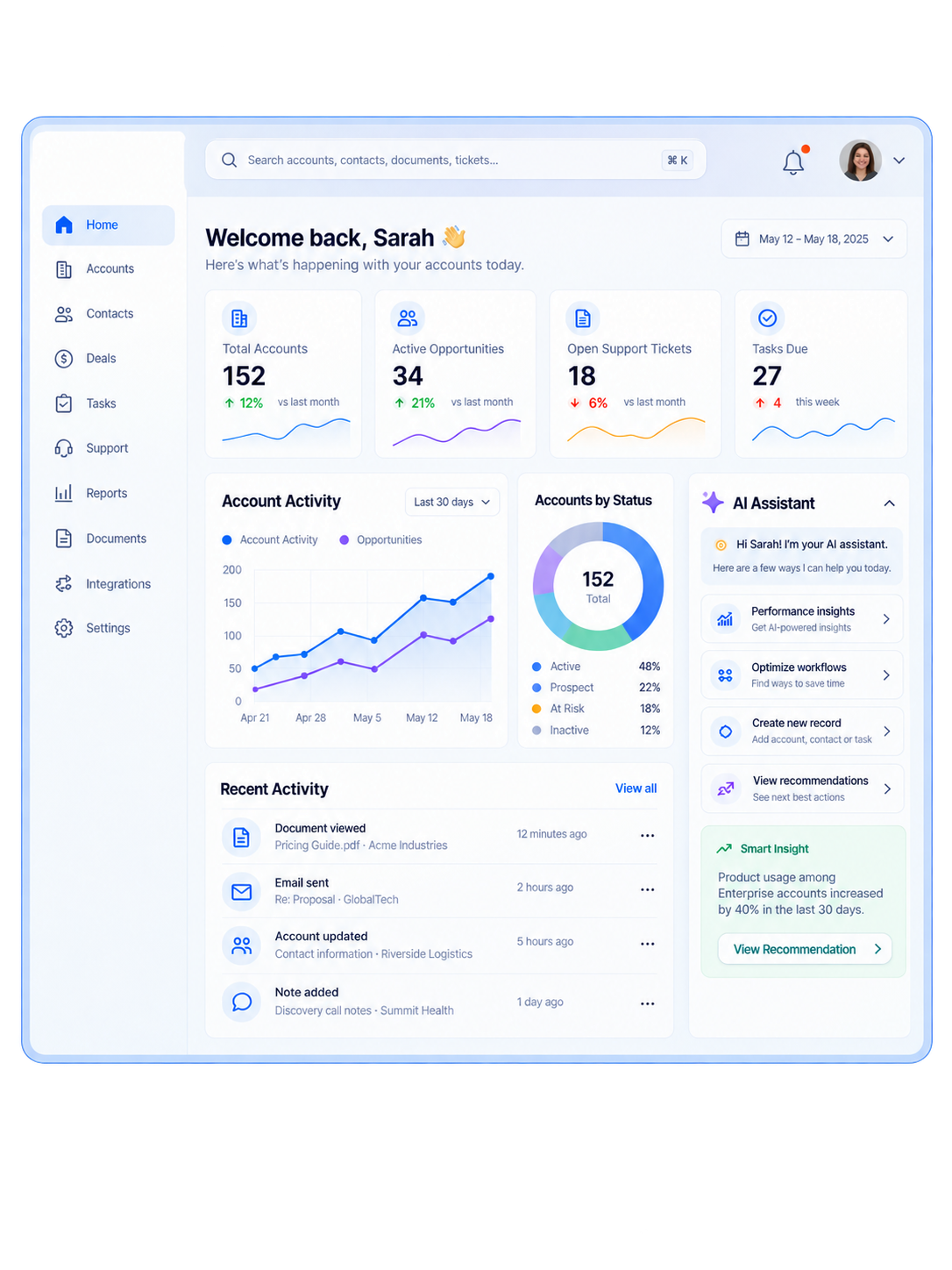
AI FEATURES ADDED WITHOUT REBUILDING THE CORE SAAS PLATFORM
An established B2B SaaS company wanted to add AI search, recommendations, and workflow assistance to an existing product. I designed the AI layer around the current architecture, permissions, and proprietary data; my team built the retrieval, model integration, evaluation, and monitoring needed to move the capability into production.
57%
Faster access to relevant product and customer information.
34%
Reduction in repetitive user tasks.
6
AI-assisted workflows added to the existing product.
B2B SaaS
LLM Integration
RAG
ROLE-BASED ACCESS
EVALS + MONITORING
Estimated Pricing
How Much Do AI Integration Services Cost?
A focused production AI integration typically starts around $20K at Neologic. Multi-system and business-critical integrations cost more because the real engineering is usually in the systems, data, permissions, workflow rules, and production controls around the AI.
FOCUSED AI INTEGRATION
From $20k
AI added to one defined workflow or existing application with accessible data and a straightforward integration path.
1 CORE WORKFLOW
1–2 SYSTEMS
DEFINED DATA SOURCE
PRODUCTION DEPLOYMENT
Best fit:
A contained use case where the workflow and integration path are already reasonably clear.
MULTI-SYSTEM AI INTEGRATION
From $40k
AI connected across several applications or data sources, with business rules, permissions, evaluation, and production monitoring.
MULTIPLE SYSTEMS
RAG / AI AGENTS
ROLE-BASED ACCESS
EVALS + MONITORING
Best fit:
AI that needs context from several systems to support or automate an operational workflow.
COMPLEX OPERATIONAL AI
From $75k
AI embedded into a business-critical environment with custom or legacy software, fragmented data, complex permissions, or regulated workflows.
LEGACY / CUSTOM SYSTEMS
FRAGMENTED DATA
SECURITY + COMPLIANCE
Best fit:
AI that becomes part of a complex operation where incorrect output or actions carry real business or compliance risk.
COST FACTORS
What Drives AI Integration Cost?
The AI model is rarely the main cost driver. Integration cost rises with the complexity of your systems, data, workflows, permissions, and production requirements.
LOW COMPLEXITY
- SYSTEMS
1–2 modern systems with documented APIs - DATA
Ready, structured, and easy to access - AI ROLE
Summarizes, searches, or assists users - ACCESS & CONTROL
Straightforward permissions - PRODUCTION
Standard testing, logging, and monitoring
MEDIUM COMPLEXITY
- SYSTEMS
Several applications, APIs, or data sources - DATA
Mixed structured and unstructured data - AI ROLE
Recommends, prioritizes, or triggers workflows - ACCESS & CONTROL
Role-based access and workflow permissions - PRODUCTION
Evals, fallbacks, and production monitoring
HIGH COMPLEXITY
- SYSTEMS
Custom, legacy, or poorly documented software - DATA
Fragmented, inconsistent, or sensitive data - AI ROLE
Agents take controlled actions across systems - ACCESS & CONTROL
Complex permissions, approvals, and auditability - PRODUCTION
Strict failure handling, observability, and recovery
MOST PROJECTS MIX THESE LEVELS.
I use discovery and prototyping to uncover the real complexity before locking the production scope and build price.
Why hire us
Why Choose Neologic for AI Integration?
Neologic is a strong fit when a packaged AI integration cannot handle the complexity of your operation. I work through your systems, data, business rules, security, and production requirements up front so my team can build against a clear architecture, scope, and budget.
Business Problem Before AI
I start with the workflow and the business problem, not a model or AI tool. If conventional automation or a simpler software change solves the problem better, I will recommend that instead.
One Accountable Architect
I stay responsible for the architecture, scope, and technical direction from discovery through launch. You are not passed between sales, account management, and engineering teams to get technical decisions made.
Production, Not Just a Prototype
I define permissions, human controls, failure behavior, and acceptance criteria before the production build. My team engineers the testing, monitoring, security, and observability needed to run the integration in a real operation.
Scope and Budget Before the Build
We use discovery and prototyping to remove the major technical unknowns first. Once the architecture and fixed scope are clear, I lock the agreed build price in writing.
Client-Owned, Model-Agnostic Architecture
I choose models and infrastructure around the use case, existing systems, security requirements, and operating cost rather than forcing every project onto one vendor. You own the custom code and IP we create, so another qualified team can maintain or extend the system if needed.
faq
Frequently Asked Questions
Can you integrate AI with our CRM, ERP, SaaS product, or custom software without rebuilding it?
Yes, in many cases. My team can connect AI to CRM, ERP, SaaS products, custom applications, databases, and legacy systems through APIs or other integration layers. I first determine what can stay in place and where targeted modernization is actually needed.
When should we use AI instead of conventional automation?
Use AI when the workflow involves unstructured information, language, classification, retrieval, recommendations, or variable inputs that deterministic rules handle poorly. If conventional automation can solve the problem more reliably and cheaply, I will recommend that instead.
What data do we need before integrating AI?
You do not need perfect company-wide data. You need data that is reliable enough for the specific task the AI will perform. I review the relevant sources, quality, access, permissions, ownership, and gaps before deciding whether the use case is ready.
How do you protect proprietary data when using AI?
I define the access model around the workflow and the sensitivity of the data. Depending on the project, my team can implement SSO, role-based access control, least-privilege permissions, controlled retrieval, audit logs, human approval, and restrictions on what data or tools the AI can access.
Can you take an existing AI proof of concept into production?
Yes. A proof of concept shows that an idea can work. Production requires real integrations, permissions, evals, failure handling, monitoring, security, observability, and clear ownership.
I assess what is missing, define the production architecture, and my team builds the production layer around it.
Can an AI integration project have a fixed build price?
Yes, once the architecture and scope are clear. I use discovery and prototyping to remove the major technical unknowns first. For fixed-scope builds, I then lock the agreed production price in writing before development begins.
How much does AI integration cost?
Focused production integrations at Neologic start around $20K. Multi-system integrations typically start around $40K, while complex operational AI projects start around $75K.
The final price depends on system complexity, data readiness, AI autonomy, security requirements, and production controls.
How long does an AI integration project take?
Typical end-to-end timelines are 6–10 weeks for a focused AI integration, 10–16 weeks for a multi-system integration, and 4–8 months or more for complex operational AI involving legacy systems, fragmented data, regulated workflows, or extensive production controls.
I confirm the timeline after discovery and prototyping, once the architecture and production scope are understood.
Do you provide generative AI and GenAI integration services?
Yes. My team can integrate generative AI into existing software, data, and workflows using models such as OpenAI, Claude, and Gemini. That can include RAG, AI search, copilots, document processing, AI agents, and other LLM-based capabilities.
I choose the model and architecture around the use case, security requirements, existing systems, and operating cost.
Who owns the AI integration after launch?
You own the custom code and IP we create under the engagement. The architecture is also designed to avoid unnecessary dependence on Neologic or a single AI vendor, so another qualified team can maintain or extend the system if needed.
get started
PUT AI TO WORK WHERE IT WILL ACTUALLY HELP.
Tell me which workflow or product capability you want to improve. I’ll look at the systems and data behind it and tell you where AI makes sense, where it doesn’t, and what I would build first.
We will get back to you as soon as possible.
Please try again later.
