
AI Development Company in Chicago
Validate the Value. Protect Your Data.
Then Build.
Neologic builds custom AI applications, AI-powered SaaS products, and business systems when standard tools fall short. I'm Dmitriy Fridlyand. I examine your business case, workflows, and data, validate critical assumptions, and define security and privacy requirements before development. My senior engineering team builds and tests the solution against agreed criteria, while I remain accountable throughout. Once you approve a fixed scope, I guarantee the agreed development price.

SECURITY BY DESIGN
Privacy, permissions, and
AI safeguards defined upfront.
$0
Unplanned costs.
I guarantee the price
of the build in writing.
WHO WE HELP
AI Development for Small and Mid-Sized Businesses
Neologic is a boutique, founder-led AI development firm for small and mid-sized businesses and product teams that need software tailored to how they operate. You work directly with me on the business problem, architecture, and decisions. I bring in senior engineers to match the actual scope, so you get personal technical accountability without assembling an internal AI team or navigating layers of agency management.
01. Building an AI-powered product
A founder or product team needs a custom AI application or SaaS product with production architecture, security, and room to grow.
02. Solving a complex business problem
An operator needs proprietary workflows, data, decision rules, or systems connected in ways standard AI tools cannot support.
03. Turning a prototype into production software
A company has an AI demo, MVP, or troubled codebase and needs an independent technical assessment and dependable engineering.
OUR SERVICES
What AI Development Services Does Neologic Offer in Chicago?
Neologic develops AI-powered applications, SaaS products, and custom systems for complex business operations. I select the architecture around the use case, proprietary data, security, and operating cost. When AI needs to work with your CRM, ERP, SaaS product, or legacy software, we preserve the systems that already work instead of prescribing a rebuild.
Custom AI Application Development
Build private business applications around your data, decisions, and workflows when generic AI software cannot handle the requirements.
AI SaaS and Product Development
Create customer-facing AI products with the required multi-tenant architecture, permissions, usage tracking, and product infrastructure.
Add AI to existing CRM, ERP, SaaS, databases, and custom or legacy applications without replacing functioning systems.
AI Agent Development
Develop agents that retrieve information, use approved tools, and perform defined tasks with permissions, human approvals, and logging where needed.
AI Workflow Automation
Automate document-heavy or variable operational work using AI where rules-based automation alone is insufficient.
Generative AI Development
Create specialized copilots, analysis tools, and content or document workflows using appropriately selected LLMs.
Custom RAG Development
Build retrieval-augmented generation systems that answer from approved company knowledge, with access rules and output evaluation.
Predictive Analytics Development
Develop forecasting and decision-support applications from business data where a generic analytics tool cannot capture the required logic.
Custom Machine Learning Development
Assess and build tailored classification, scoring, or recommendation models when the available data and business case support them.
AI Consulting and Feasibility Assessment
Evaluate buy-versus-build options, data readiness, architecture, operating costs, and technical risks before committing to development.
CUSTOM AI USE CASES
What Custom AI Applications Can We Build for Your Business?
We build AI-powered products and business tools when standard software cannot handle proprietary data, unusual workflows, complex integrations, or specific security requirements. These examples show where custom engineering may be justified, not a reason to custom-build every common AI feature.
AI-Powered SaaS Platforms
Build a customer-facing product with AI search, recommendations, reporting, or agent features when the business model requires custom workflows, permissions, or multi-tenant behavior.
AI Document Processing and Contract Review
Extract, classify, compare, and route information from invoices, forms, and contracts using business-specific rules, approvals, and traceable outputs.
AI Knowledge Base and Internal Assistants
Use custom RAG to retrieve answers from proprietary policies, records, and documents while respecting each user's access permissions.
AI CRM and Sales Automation
Build AI-assisted lead qualification, sales insights, follow-ups, and CRM workflows when proprietary sales rules or multiple data sources go beyond standard CRM features.
AI Customer Support Automation
Develop support assistants that use approved customer history, product data, and policies to draft or resolve routine requests and escalate exceptions to people.
AI Recruiting and HR Automation
Build intake, document review, candidate communication, and onboarding workflows around existing HR systems, privacy requirements, and human-led employment decisions.
AI Demand Forecasting and Predictive Analytics
Evaluate historical business data to forecast demand, workload, or resource needs when generic tools cannot model the relevant variables.
AI Fraud Detection and Anomaly Detection
Evaluate custom risk signals and flag unusual activity for human investigation, subject to data feasibility and validated model performance.
THE PROBLEM-TO-PRODUCTION AI FRAMEWORK
How Does Our AI Development Process Reduce Risk?
I begin by defining the business result the software needs to deliver, the current workflow, and the important technical unknowns. The process makes decisions visible before the client commits to a large build: assess, validate, approve scope and acceptance criteria, then engineer and measure.
01. Discovery Call
02. Business & Technical Audit
03. Validate & Approve
04. Engineering & Testing
05. Launch & Support
01
Get a Clear Direction for Your AI Project
30–60 MIN
YOUR PROJECT, CLARIFIED
NEXT STEPS
You bring the project. I review what you want to build, where it stands, and what could affect delivery. For an AI SaaS project, I review target users, the core product value, and first-release priorities. For operational AI, I examine the workflow, data, and existing systems. For a prototype, I identify what needs a technical review. I flag the biggest early uncertainties and explain which decisions need discovery before development starts.
WHAT YOU GET
• An initial technical assessment of your project and its main risks
• A clear next step: product discovery, workflow audit, AI proof of concept, or code review
02
Map Your Business, Data, and Risks Before Design
1–3 WEEKS
DATA READINESS
SECURITY & PRIVACY
I inspect the actual workflows, stakeholders, exceptions, current software, data sources, and integration requirements. This includes access controls, data privacy, AI compliance obligations, where human judgment must stay involved, and the baseline needed for an AI ROI assessment.
The audit can include onsite workflow observation in the Chicago area when that reveals operational details a remote review would miss.
WHAT YOU GET
• Business Requirements Document (BRD)
• Workflow map, data-readiness findings, and systems inventory
• Security/privacy requirements, risk register, and initial architecture recommendation
• Baseline metrics for evaluating potential AI ROI, where measurable
Learn more:
Neologic Software Product Discovery
03
Prove the Approach and Approve Scope Before the Build
1–2 WEEKS
GO / NO-GO DECISION
FIXED-SCOPE PRICE
I select the validation work that addresses the largest unknown. You will be able to review the evidence, requirements, acceptance criteria, and exclusions before approving development. If the approved fixed-scope project proceeds, I guarantee the agreed development price; additional scope is approved and priced separately.
Validation methods:
- a clickable prototype for interface-heavy AI applications and user journeys;
- a technical proof of concept (PoC) for model behavior, retrieval quality, or data feasibility;
- an architecture and code audit for an existing AI MVP or troubled software project.
WHAT YOU GET
• Validation findings and the relevant prototype, PoC report, or architecture assessment
• Approved functional/nonfunctional requirements and testable acceptance criteria
• Architecture specification and Statement of Work (SOW) with inclusions, exclusions, milestones, and agreed fixed-scope build price
Learn more:
Neologic Software Development Budget Guarantee
Neologic Software Prototyping Services
04
Build and Test Against the Approved AI Requirements
AGREED TIMELINE
SECURITY & EVALS
CHANGE CONTROL
My engineering team builds the approved system and tests AI behavior, data permissions, edge cases, failures, and production infrastructure.
I remain accountable for architecture and scope decisions. Testing includes the agreed AI security, privacy, and compliance controls.
WHAT YOU GET
• Tested AI application or software deliverables against the agreed acceptance criteria
• Test/evaluation results, approved change records, and deployment documentation
05
Launch the AI System, Measure Results, and Keep Control
PRODUCTION GO-LIVE
MEASURABLE RESULTS
IP OWNERSHIP
My team deploys the solution, prepares the handoff, and implements the agreed monitoring and support.
Actual usage, quality, and costs are measured against the baseline; findings can guide later improvements without silently expanding the original project.
WHAT YOU GET
• Production deployment, runbook/technical documentation, and agreed training or handoff
• Monitoring and performance measures, with support options defined in the agreement
• Contract-defined ownership of delivered custom code/IP and clear third-party model/licensing boundaries
AI SECURITY & DATA PRIVACY
How Do We Address AI Development Security, Data Privacy, and Compliance?
I define the data, access, deployment, model, and compliance requirements during the audit, before approving the architecture. My engineering team implements and tests the agreed controls, including how the AI behaves when answers are wrong or systems fail. The AI Development Process shows when these decisions are made. Security is part of scope approval and production acceptance, not a last-minute checkbox.
01. AI DATA PRIVACY
Where Does Your Data Go?
I evaluate where sensitive data can be processed: a managed model API, an approved private-cloud environment, or a self-hosted/open-weight model where feasible. I compare model capability, data residency, contractual retention and training terms, infrastructure responsibility, and operating cost. A self-hosted model is not automatically more secure; the architecture and controls still matter.
02. ACCESS CONTROLS
Who Can See or Change What?
I define roles, permissions, and limits on AI tool access. My team implements the agreed boundaries, including tenant separation and human approval for sensitive actions where relevant.
03. AI DEVELOPMENT SECURITY
What Happens When AI Gets It Wrong?
My team tests realistic failure cases, including incorrect answers, prompt injection, potential data exposure, and unintended actions. We add appropriate evaluations, fallbacks, and review points.
04. AI COMPLIANCE
Which Requirements Apply?
I assess the applicable privacy, regulatory, and contractual obligations. My team implements the agreed controls, audit logging, and monitoring; compliance depends on the whole deployment and operating environment.
AI TECHNOLOGY STACK
What Technologies Do We Use for Custom AI Development?
I choose the AI models, software architecture, and infrastructure around what your application needs to do, the data it uses, security requirements, and ongoing operating costs. My team builds the complete application around those decisions. Where practical, we keep the AI layer flexible so you can change models as the technology evolves.
AI Models
LLM Integration
Multimodal AI
OPEN + PROPRIETARY MODELS
Search, RAG & Retrieval
semantic + hybrid search
private knowledge
vector + keyword retrieval
AI Agents & Orchestration
TOOL USE
MCP
HUMAN APPROVAL
Integration & Backend
REST APIs
WEBHOOKS
CUSTOM CONNECTORS
Production, Security & Observability
EVALS + TRACING
SSO + ROLE-BASED ACCESS
MONITORING + FALLBACKS
INDUSTRY EXPERIENCE
Which Industries Can Neologic Serve With Custom AI Development?
Neologic works with businesses whose workflows, sensitive information, and operational rules are not well served by generic tools. The examples below are potential custom AI applications informed by our software-domain experience.
AI Development for Healthcare
Build AI applications that simplify care documentation, retrieve clinical and operational information, and automate administrative workflows. We design around sensitive healthcare data, access controls, applicable HIPAA requirements, and human oversight.
AI Development for Legal Services
Put AI to work reviewing contracts, searching case documents, and streamlining client intake. My team develops custom applications around your legal workflows, with confidentiality, access permissions, auditability, and attorney review built into the design.
AI Development for Real Estate
Turn property records, leases, portfolio data, and CRM information into useful AI-powered workflows. From document processing to portfolio analysis and client management, we build around your business rules and existing systems.
AI Development for Education
Custom AI applications can help schools, education providers, and learning platforms manage knowledge, process documents, and automate administrative tasks. Each solution is designed around student-data privacy, access permissions, and staff oversight.
AI Development for Logistics
Use custom AI to identify shipment exceptions, process transportation documents, forecast demand, and support dispatch decisions. We build around your operational data, existing systems, and logistics-specific workflows.
Custom AI Development for Your Industry
Don't see your industry? I start by understanding your workflows, data, and business requirements. If standard software can't handle them, my engineering team can build an AI solution tailored to your operation.
AI PROJECT ROI
How Do You Evaluate Custom AI Development ROI Before Investing?
ROI evaluation starts in discovery, not after the system goes live. I establish the baseline and key assumptions during the business and technical audit, test the highest-risk assumptions during validation, then compare actual results and operating costs after launch.
01
Establish the Business Case
I assess current costs, potential savings, and revenue opportunities. We establish a baseline and measurable success criteria.
02
Validate Before You Invest
I test data quality, AI accuracy, and technical feasibility through an assessment or proof of concept before full development.
03
Calculate the Full Investment
I compare projected benefits with development, model usage, hosting, and maintenance costs, estimating payback where feasible.
04
Optimize AI Operating Costs
I select cost-effective architecture upfront. After launch, we track cost per task and optimize models, caching, and usage without compromising quality.
OUR AI PROJECTS
What Results Have We Delivered With AI?
HEALTHCARE
LOGISTICS
B2B SOFTWARE
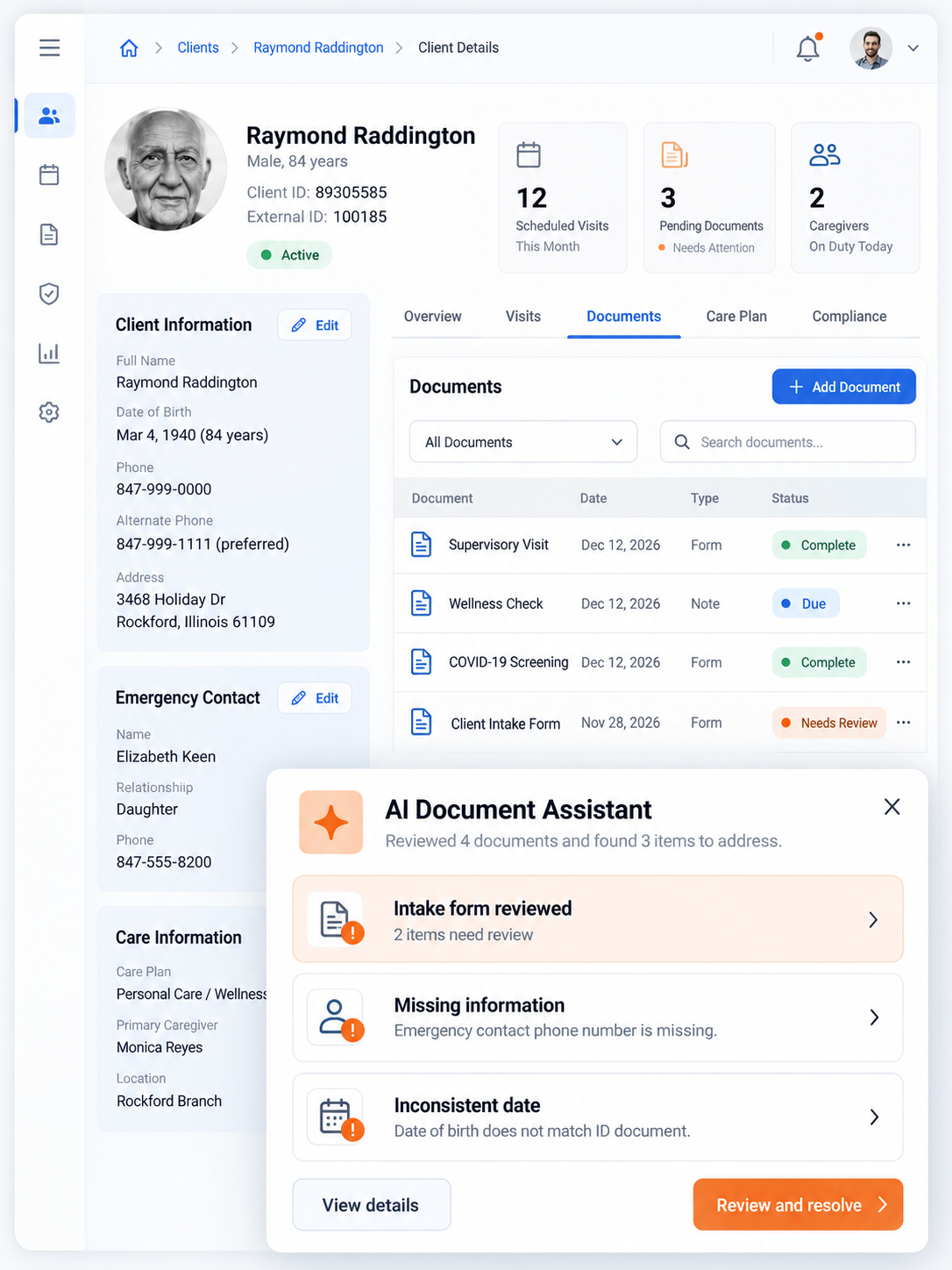
AI Document Review & Operational Monitoring
for Home Care
A multi-location home-care provider managing thousands caregivers needed to reduce manual work across documentation, scheduling, visits, and compliance.
I designed the AI solution around the custom operational platform my team had already built. An AI document assistant reviews submitted records, identifies missing or inconsistent information, and flags exceptions for staff. Operational dashboards help managers see what needs attention without searching through multiple workflows.
What made it different: The AI works with the agency's existing data, business rules, and access permissions. Staff remain responsible for compliance-sensitive decisions.
Business value: Less routine record checking, earlier visibility into exceptions, and better control over complex home-care operations.
Home Care
AI DOCUMENT PROCESSING
COMPLIANCE REVIEW
WORKFLOW AUTOMATION
Human Review
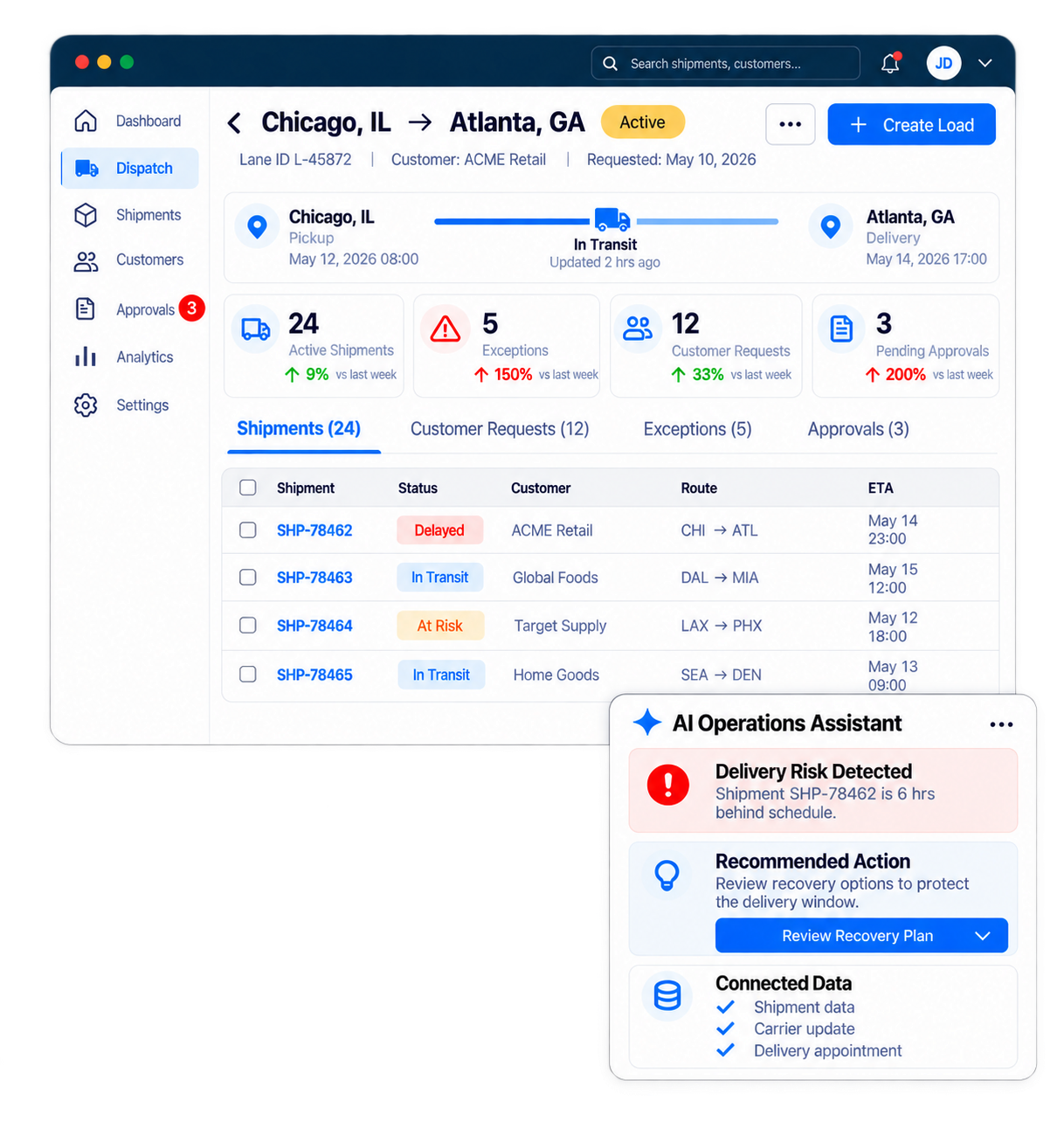
Custom AI Agent for Dispatch and Operational Decisions
A logistics company needed staff to make faster decisions across dispatch, shipment updates, customer requests, and internal applications. I designed an agent workflow to pull context from multiple systems, detect exceptions, and prepare actions for employee approval. My team implemented the AI connections and the controls required for production.
44%
Faster handling of operational exceptions.
85+ hrs
Manual coordination eliminated each week.
31%
Reduction in repetitive status and data-checking work.
Logistics
MULTIPLE SYSTEMS
AI AGENTS
APIs
HUMAN APPROVAL
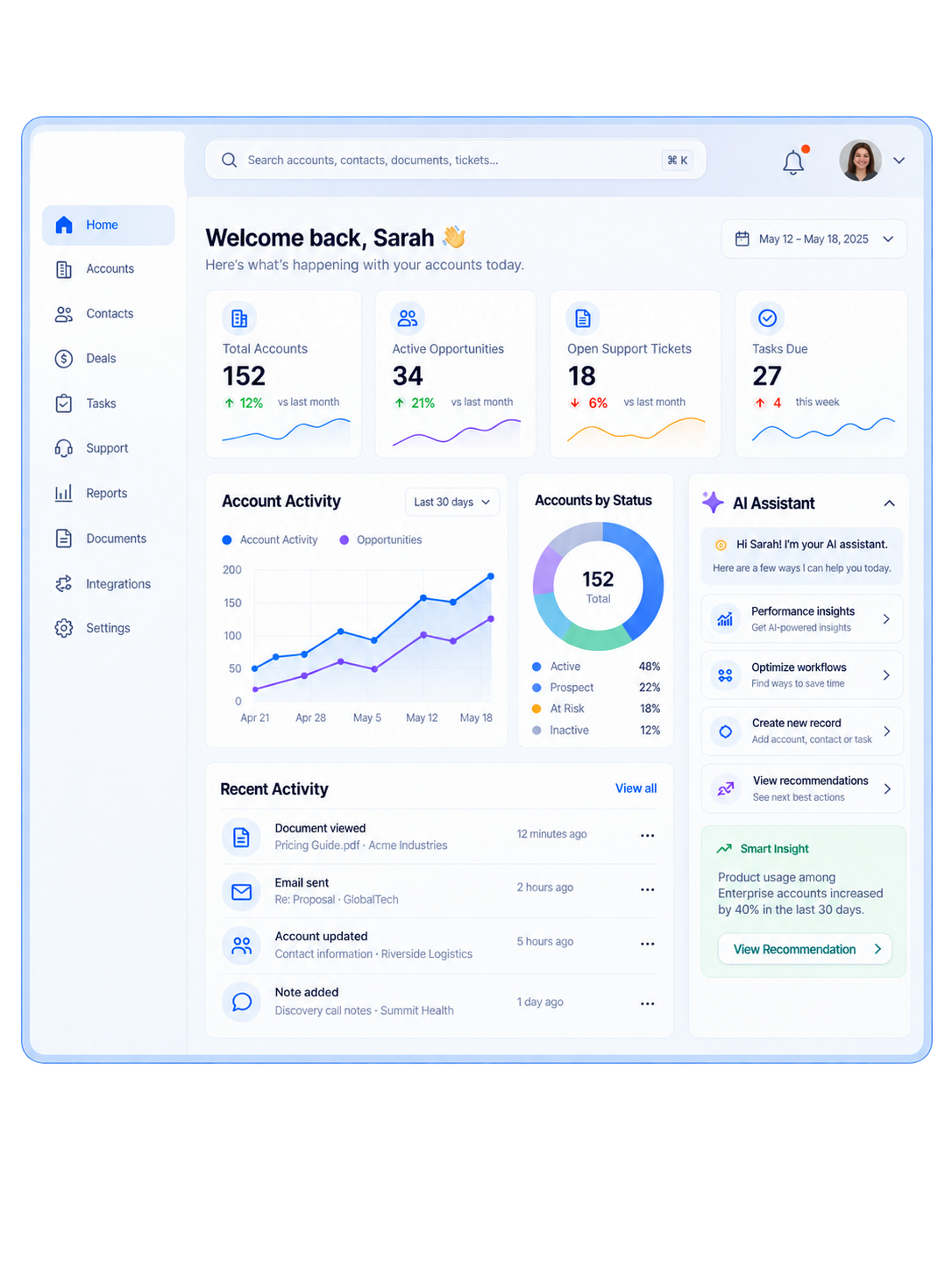
Production AI Features Without a Platform Rebuild
An established B2B SaaS company wanted AI search, recommendations, and workflow assistance inside its existing product. I designed the AI layer around the application's permissions, architecture, and proprietary data. My team developed retrieval-augmented generation (RAG), model integration, evaluation, and monitoring.
57%
Faster access to relevant product and customer information.
34%
Reduction in repetitive user tasks.
6
AI-assisted workflows added to the existing product.
B2B SaaS
LLM Integration
RAG
ROLE-BASED ACCESS
EVALS + MONITORING
WHY NEOLOGIC
Why Choose Neologic as Your AI Development Company in Chicago?
You need custom AI that handles your actual workflows, data, and compliance requirements, not just an impressive demo. I learn how your business works before defining the solution. You work directly with me throughout the project, with face-to-face meetings in the Chicago area or wherever you are in the USA. My engineering team builds and tests the agreed solution. I remain accountable for the technical decisions and delivery.
Deep Business Diagnosis
I examine workflows, exceptions, data, and the cost of the problem before defining a solution. Chicago-area onsite audits are available where needed.
Security for Sensitive Workflows
I bring 10+ years of experience with highly regulated industries, including HIPAA projects, along with work in confidential legal workflows. Privacy, access, and human review are defined before the build.
Evidence Before Full Commitment
The right prototype, PoC, or technical audit tests the project's critical assumptions. You review findings and acceptance criteria before making a go/no-go decision.
One Accountable Principal
I own architecture, scope, and client communication. Senior engineering specialists join the project as required, without selling headcount as the benefit.
Guaranteed Fixed-Scope Build Price
I guarantee the agreed development price after you approve the scope and acceptance criteria. Any additional work is priced and approved separately.
COST & BUDGET
How Much Does Custom AI Development Cost?
Custom AI development cost depends on what software must be built around the AI, not only on model API fees. A new AI-powered application, an AI SaaS product, and a predictive system have different scopes and cost drivers. I price the agreed fixed-scope build after requirements and architecture are validated, rather than applying integration-package rates to a new product.
AI DOCUMENT REVIEW APPLICATION
From $35K
A private application that extracts information from one defined document category, flags exceptions, and sends results to a human review queue. Assumes a proven model API, limited user roles, one primary workflow, and straightforward data access.
AI-POWERED SAAS MVP
From $60K
A focused, customer-facing knowledge or document-analysis SaaS product with secure logins, basic tenant separation, one core RAG/AI feature, and a limited first-release feature set.
CUSTOM PREDICTIVE ANALYTICS SYSTEM
From $75K
A demand-forecasting application using an accessible, usable historical dataset, one defined prediction target, model evaluation against a baseline, and a decision-support dashboard. Excludes major data remediation and extensive integrations.
COST FACTORS
What Drives AI Development Cost?
I establish the architecture, acceptance criteria, inclusions, and exclusions before guaranteeing the agreed fixed-scope development price. Scope changes are quoted and approved separately; third-party usage and ongoing support are budgeted separately unless the contract says otherwise.
Product scope
Screens, user roles, workflows, and integrations
Data and AI complexity
Preparation, retrieval, model choice, evaluation, and required accuracy
Production controls
Security, privacy, compliance, resilience, and observability
Ongoing operation
Hosting, model/API usage, storage, support, and maintenance
REQUIREMENTS & VALIDATION → APPROVED FIXED SCOPE → GUARANTEED AGREED BUILD PRICE
COMMON QUESTIONS
What Should You Know Before Hiring an AI Development Company?
When Does Custom AI Development Make More Sense Than Buying Existing Software?
Custom AI development makes sense when existing products cannot handle your proprietary workflows, data, business rules, or security requirements without expensive workarounds.
I evaluate existing tools and integration options before recommending custom development. If a simpler solution will deliver the same result, I'll recommend it.
What's the Difference Between Custom AI Development and AI Integration?
Custom AI development creates new applications, SaaS products, or proprietary AI systems. AI integration adds AI capabilities to software you already use.
A project may involve both. If your main objective is adding AI to existing CRM, ERP, SaaS, or operational systems, see our AI Integration Services.
Can AI Work With Our Existing Software and Data?
Usually, yes. I assess your existing CRM, ERP, databases, SaaS tools, and legacy systems to determine which data the AI needs and how it can be accessed securely. My team builds the necessary connections where feasible, so the new AI application can work with your current systems instead of forcing a replacement.
Can You Build an AI-Powered SaaS Product From Scratch?
Yes. I help define the MVP, prioritize features, and design the architecture around your product and business model.
My engineering team builds the application, including AI functionality, user management, multi-tenant architecture, billing integrations, and other production requirements as needed.
Can You Turn an AI-Generated MVP or Prototype Into Production Software?
Yes, provided the underlying approach is viable. I assess the existing code, architecture, AI functionality, security, and scalability to determine what can be reused.
My team then addresses the gaps needed to make the application reliable, maintainable, and ready for real users. A complete rebuild isn't always necessary.
Do We Need to Train Our Own AI Model to Build a Custom AI Application?
Usually not. Many custom AI applications can use existing large language models (LLMs), retrieval-augmented generation (RAG), or open-weight models.
I recommend fine-tuning or custom model training only when the requirements, available data, and expected benefits justify the additional cost and complexity.
Will Our Proprietary Data Be Used to Train Third-Party AI Models?
That depends on the selected model provider, deployment method, and contractual terms.
I review data retention, model training policies, and private deployment options before choosing the architecture. Your data privacy requirements determine which options are acceptable.
Can We Stop After Discovery or a Proof of Concept Without Committing to Full Development?
Yes. Discovery and validation are decision points, not automatic commitments to a production build.
I document the findings, technical risks, requirements, and proposed scope. You can review the results and decide whether to proceed. The deliverables and fees for each engagement are defined in the agreement.
Who Owns the Custom AI Software and Intellectual Property?
You receive ownership of the delivered custom code and intellectual property as specified in our agreement. You also have access to the project's code repository from the start, not just at handoff.
My team documents the architecture and deployment so your developers, or another qualified partner, can maintain and extend the software.
What Happens When AI Models Change or Performance Declines After Launch?
AI models change quickly. Where practical, I design the application to be model-agnostic: its core business logic isn't tied to one model provider. That makes it easier to move to a newer, better, or less expensive model without rebuilding the application.
My team still tests each model change for accuracy, security, compatibility, and cost. Under an agreed support plan, my team can monitor performance and implement updates.
SPEAK WITH DMITRIY
Have an AI Project? Talk Directly With Dmitriy.
Tell me what you want to build or where your existing AI project stands. I'll review the goal, flag the most important early questions, and recommend a practical next step. Chicago-area meetings are available by arrangement, and I work with clients across the United States.
We will get back to you as soon as possible.
Please try again later.
